
I did some analysis of the stated values of corporations. One thing I’ve discovered is that some corporations promote a list of words they claim are values, but really aren’t. For example, “people” or “product.” These aren’t values, they’re just categories of concern (love that term). Which means they fail to do the two things that a core value must do.
To make sure you know how to write effective core values, let’s establish what actually qualifies as a core value.
A core value is a word or phrase that does two things:
1. Guides behavior and decision-making.
2. Distinguishes right and wrong.
That’s my own thinking. But for purposes of this post, I thought I should look for some other definitions. Lo and behold, I found this from the Cambridge Dictionary: Values are “the principles that help you decide what is right and wrong and how to act in various situations.” Hey, that’s what I said!
Okay, now let’s expand on these two ideas. What makes a value a value?
Let’s take “people” for example. “People” is not a value. How does “people” guide one’s actions? I mean, imagine: “Let’s see, what do I do in this situation? Oh yeah… PEOPLE. There’s my answer.” That makes no sense.
What we’re probably trying to say here is that people are important (which is a belief, not a value)… OR… that we genuinely care about our employees or even prioritize them (which starts to feel like a value).
To be fair, “people” might simply be a heading… followed by a couple of sentences of body copy to explain what’s really meant by that word. Problem: That’s two layers of information. It’s more complex than it needs to be: Hard for people to process; hard for people to remember. If values are going to guide behavior every single day, they’d better be simple… distilled to single words or brief expressions.
Therefore, “people” should be “caring for employees” or “employee-focused” or “put employees first” or something like that.
You see here that the way you say things matters. Word choice makes all the difference between vague and clear. It’s how you turn a “category of concern” into an actual criterion.
Sidebar: Typically, values are best expressed as adjectives or imperatives. But some nouns can get the job done… like integrity, innovation, and craftsmanship. (Not very compelling, but they work.)
If values are going to guide behavior every single day, they’d better be simple.
If a value is supposed to guide your decision-making, then it needs to help you distinguish between a good decision and a bad decision. Between right and wrong.
So in the business world, a core value is a declaration of what is right. Which means it has to have an opposite wrong. This is a test you can apply.
“Caring for employees” is a value because it declares the right thing to do. Simultaneously, it implies that its opposite, “not caring for employees,” is the wrong thing to do. Thus it’s a valid guide for behavior and decision-making.
A core value is a declaration of what is right. Which means it has to have an opposite wrong.
With the above principles in mind, let’s take a look at three real-life examples.
First up, NOW Foods. On their core values page they say, “A helping hand since 1968.” Accordingly, they use the five fingers of a hand to count off their guiding principles. And I always appreciate a good visual device. But on the other hand (haha), it’s a bit cutesy.
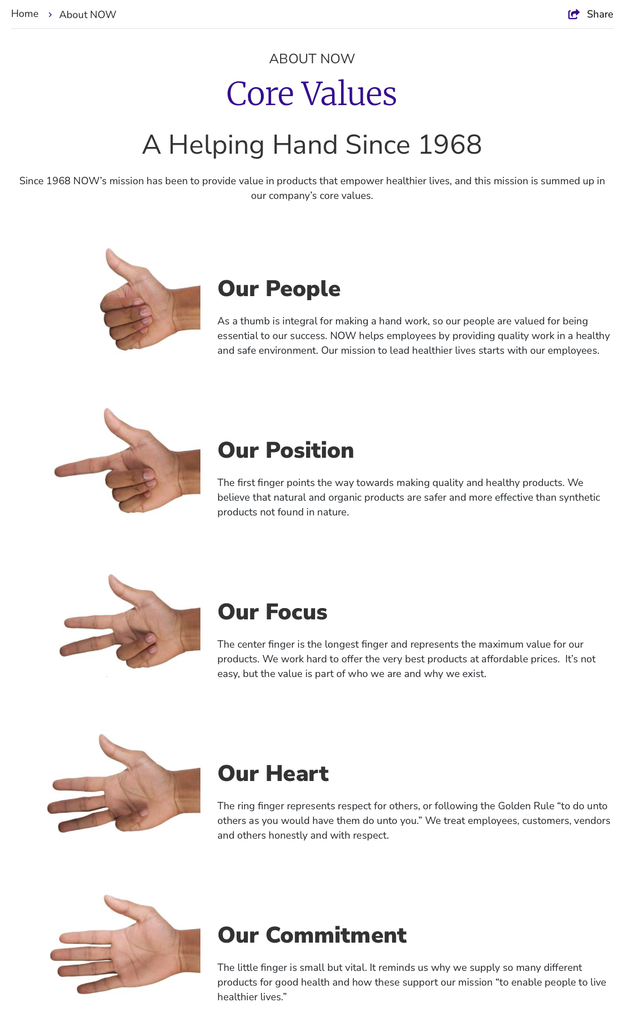
Nevertheless, on to their words. To be fair, I’m going to include them here in their entirety. But for our purposes, you can just give them a skim.
Here are the core values of NOW Foods:
Our People
As a thumb is integral for making a hand work, so our people are valued for being essential to our success. NOW helps employees by providing quality work in a healthy and safe environment. Our mission to lead healthier lives starts with our employees.
Our Position
The first finger points the way towards making quality and healthy products. We believe that natural and organic products are safer and more effective than synthetic products not found in nature.
Our Focus
The center finger is the longest finger and represents the maximum value for our products. We work hard to offer the very best products at affordable prices. It’s not easy, but the value is part of who we are and why we exist.
Our Heart
The ring finger represents respect for others, or following the Golden Rule “to do unto others as you would have them do unto you.” We treat employees, customers, vendors and others honestly and with respect.
Our Commitment
The little finger is small but vital. It reminds us why we supply so many different products for good health and how these support our mission “to enable people to live healthier lives.”
Okay, I don’t doubt their sincerity. But other than the finger-counting thing, they just don’t make it easy for people to remember and apply the underlying ideas.
My comments:
Now I can hear somebody out there arguing: “’Focused’ instead of focus… ‘Committed’ instead of commitment… Sheperd, you’re just quibbling over word forms.” Darn right I am. As illustrated earlier, the way you say things matters.
Here’s a quick stab at improvement… a before-and-after core values comparison:
| Before | After |
|---|---|
| Our people | People-driven |
| Our position | Quality-conscious |
| Our focus | Maximum value |
| Our heart | Respect for others |
| Our commitment | Commitment to health |
NOW (haha) they feel a lot more like criteria than categories of concern. Which means they’re more applicable and more actionable.
You can still have explanatory body copy. The difference is, you’re no longer relying on it for clarity.
And, you can still do the finger-counting thing. I guess. If you really want to.
Another notable example comes from a company called Standard Process (cool name). When I started writing this post, their corporate values appeared at the bottom of their About Us page. They’re gone now, unfortunately. But I got ’em here.
This is the list of core values for Standard Process:
Person
By fostering the physical, emotional, intellectual, and spiritual health of customers and employees
Product
By emphasizing the importance of concentrated whole food-based ingredient sources and herbs in the product line
Process
By ensuring the highest quality in every stage of development, from farming through shipping
Planet
By utilizing environmentally safe farming, manufacturing, and business practices
Posterity
By preserving and strengthening the company for all future generations
Notice the alliteration. Mnemonics are good if they’re tone-appropriate and not forced. You be the judge here.
Again, we have categories of concern rather than standards for behavior. And again, these function as labels for the clarifying copy that follows. Elaborating with copy is good, for sure. But as we’ve established, values should be clear enough to work on their own without an explanation.
Let’s have a go at translating their meaning into more user-friendly language. Here’s another before-and-after core values comparison:
| Before | After |
|---|---|
| Person | Care for people |
| Product | Whole-food nutrition |
| Process | Highest quality throughout |
| Planet | Environmental stewardship |
| Posterity | Building for the future |
Can you feel the difference? The “after” values are shorter and easier to remember than the descriptions. And they’re more specific and clear than the labels.
Values should be clear enough to work on their own without an explanation.
If I’m going to hold other companies’ feet to the fire, it’s only fair that I should do the same for my own.
At Counterpart, our core values are:
Can these guide behavior? Absolutely. In fact, we actually call them “behavioral standards” (which is straight out of our Single Slide Strategy® framework). These are clear imperatives that makes sense without any further explanation.
They also pass the right-versus-wrong test:
I’ll preach it again: Word choice matters. It can make all the difference in meaning, memorability, and motivational power. Values are critical and permanent — they are well worth getting right.
If you’ve been tasked with composing your company’s core values, congratulations! You should feel flattered. That’s a very important job.
First thing I would tell you is that you don’t have to start from scratch. I believe your values already exist; you just have to bring them out. Hopefully this idea dials down the intimidation factor for you.
As far as expressing those values, I’ve got a simple core values diagnostic you can use: five things that make core values effective.
Are your values actually values? Put ’em to the test. Here are five things that make core values effective:
These five questions help you understand what makes core values effective.
You need to ask this question. And now you’ve got a test to help you answer it.
(If you need more help — because getting the words right really matters — get yourself a counterpart for that.)
Once you’ve got your core values on lock, next you need to figure out how they fit with your vision, mission, belief, and all the rest of your guiding principles. There’s a framework for that. It’s called Single Slide Strategy®.
